ETHN 3120: CHICANO/A/XS IN THE UNITES STATES – FALL 2023
TITLE:
Justice For Ohio Farmworkers
MEET THE DOCUMENT:
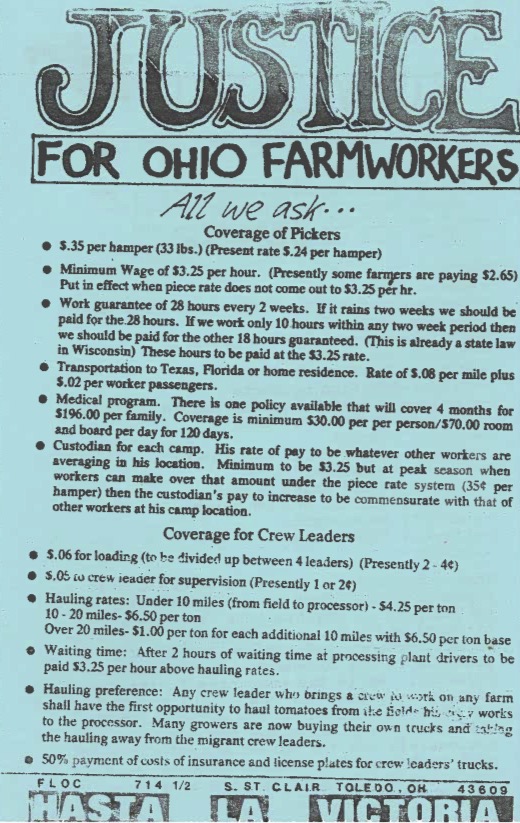
This source appears to be a flier or a letter of advertisement and information. It details what the Ohio Farmworkers are asking for, what they are facing, and who they want to boycott due to their treatment. It was written by FLOC in Toledo. It consists of demands on minimum wage, guaranteed work hours, transportation means and costs, hauling rates, medical aid, programs, etc. At the bottom, it reads, “Hasta La Victoria,” which I believe is a saying similar to “Until Victory.”I found it most interesting because I have never seen a boycott this large. Usually, when I see boycotts, it’s for one brand or one item. Here, the boycotts are endless. However, this is probably the way It should be done. As the source mentions, parent companies and things of that nature overlap. In a way, the tactics were very blunt. Instead of putting a band-aid on a wound, they went straight to surgery to fix the root problems. It isn’t easy to do so, and very honorable.
OBSERVE ITS PARTS:
The flier was made by those in FLOC living in Toledo, Ohio. It was made somewhere between 1975 and 1981. It was made for those participating in the boycotts due to the treatment they faced, especially farmworkers and anyone who supported the cause. It is hard to say who and where exactly these fliers were. I could envision it. At meetings and on the walls of businesses, especially those they are boycotting.
TRY TO MAKE SENSE OF IT:
The flier is informational; on the backside, it gives an entire list of companies to boycott and explains why, as well? Farmworkers were horribly treated with meager pay, and they were being exploited for cheap labor. When companies try to deflect responsibilities and accountability onto the growers, the farmworkers already planned for that and made the issue known. The grower and the companies work together already, so they must work together to improve working conditions and pay for their workers. All of these issues occurred during the farm crisis of the 1970s and 80s is occurring. The flier states, “While the companies insist they have no responsibility for the plight of farmworkers and that the grower is the employer, our union recognizes that the company is ultimately responsible for the worker’s conditions and must work together with the grower to bring about economic change for the worker.”
USE IT AS HISTORICAL EVIDENCE:
The strikes, protests, and issues of farmers and farm workers aren’t discussed much, especially considering the vast impact agriculture and its markets have had on the United States. A substantial spider web of interconnecting companies in the food industry is even further tied to other sectors. This proves the point of the FLOC flier: even if the companies are not directly creating working conditions, it is still their responsibility. If they can reap the benefits of the capitalistic intersections between businesses and industries, they must also reap the duties. I didn’t even know there was a farm crisis or such significant boycotts from farmers until this flier and the research afterward. Many more archival-type materials from FLOC relate to this specific flier and, when combined, could create in-depth knowledge about FLOC and the treatment of farmworkers in Northwest Ohio and across the nation.