ETHN 3120: CHICANO/A/XS IN THE UNITES STATES – FALL 2023
TITLE:
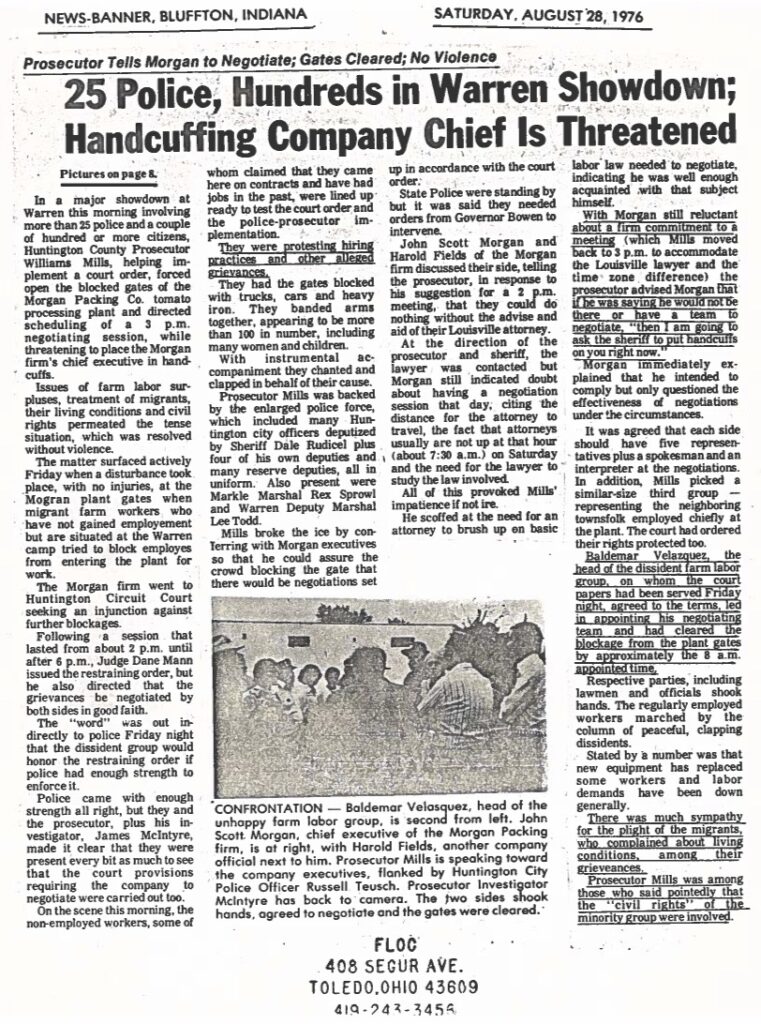
25 Police, Hundreds in Warren Showdown; Handcuffing Company Chief Is Threatened
MEET THE DOCUMENT:
This archival document is a newspaper page printed on Saturday, August 28, 1976. It is typed out, likely on a typewriter, and then mass-produced with a printing press. It is all written by the same person, an editor for the News-Banner newspaper publisher, although the article has no name. At the bottom of the middle column of the page, there is an image of Baldemar Velasquez, head of the unhappy farm labor group, and John Scott and Harold Fields, Morgan packing firm executives, shaking hands and coming to an agreement to negotiate before the gates were cleared.
OBSERVE ITS PARTS:
The article was likely read primarily by members of the Warren community, especially those involved with the Morgan Packing Co. tomato processing plant, such as employees or the families of those who depend on their income from the firm. Additionally, this newspaper was likely read by many other migrant workers who experienced similar issues with their employer, as there are many different farm labor groups across the Midwest, and these types of industries are not usually friendly to all their employees. This newspaper was also likely read by many executives of other packing plants that require migrant workers, as they feared that the police would side with the activists and force a negotiation to take place, setting a precedent for other firms to do the same.
TRY TO MAKE SENSE OF IT:
This archival document is a newspaper page printed on Saturday, August 28, 1976. It discusses the showdown between unemployed migrant farm workers stationed at the Morgan Packing Co. plant and other citizens preventing actual employees from entering the plant for work. As a result of this conflict, the Morgan firm went to Huntington Circuit Court to seek an injunction or a court order that prevented the unemployed migrant workers from continuing to block the gates for others to work as a form of activism. The activists said they would agree to the injunction if the police could enforce it. Police came out with enough strength on Friday, August 27, 1976, and brought the prosecutor and investigator to see that the court provisions that required the company to negotiate were also carried out. On the scene this morning were the non-employed workers, who claimed that they came here on contracts with the packing plant and have had jobs in the past, lined up ready to test the court order and the police-prosecutor implantation. These non-employed workers claimed they were protesting the hiring practices and other alleged grievances done to them by the packing plant. Activists had the gates blocked with trucks, cars, and heavy iron. They all banded together and appeared to be more than 100 people, including many women and children. Prosecutor William Mills broke the ice by talking with Morgan executives to ensure that negotiations would be set so that he could assure the crowd that the firm would be willing to negotiate. However, Morgan firm executives told Mills once he suggested a 2 p.m. meeting time to the crowd that they could not negotiate without the Badvice and aid of their Louisville attorney. The lawyer was contacted as ordered by the prosecutor and sheriff. However, Morgan executives still found it doubtful that they could organize a negotiation that day due to the distance their attorney had to travel and the fact that attorneys are not usually awake that early on a Saturday. All this provoked prosecutor Mills, who was scornful about the need for an attorney with basic labor law to negotiate, as he was well educated with that subject himself. The Morgan firm was still reluctant to commit to a time to deal, and the prosecutor stated that if Morgan executives were unwilling to negotiate, then he would ask the sheriff to put handcuffs on them. The executives explained that they intended to comply but only questioned the effectiveness of these negotiations. After some discussion, each side agreed to have five representatives and a spokesman and interpreter at the negotiations. Mills also suggested that a third party be involved that would represent the neighboring community employed chiefly by the plant, as the court had ordered their rights to be protected, too. The head of the dissident farm labor group, Baldemar Velasquez, agreed to the terms during the negotiations and cleared the blockage from the plant gates by 8 a.m.
USE IT AS HISTORICAL EVIDENCE:
This document taught me that migrant workers often have disputes with their employers. This is often due to working conditions and the contracts between the packing firm or other agricultural company and their labor force, typically made up of migrant workers who agree to come to the United States and work for the company. However, these disputes arise when the contract does not meet all the criteria that the firm promised, such as not employing all migrant workers who agreed to come work for the company and are now stuck in the United States as illegal immigrants with no employment. I have found that the workers are usually violated of their civil rights and have no other choice but to engage in protest by their employer, as they either can become employed or remain an illegal immigrant. These issues have occurred many times in the United States and are still happening today. It is not solely agricultural industries that engage in this type of behavior, but any industry that can utilize cheap migrant workers and attempt to increase profits by sacrificing the civil rights of their employees.