ETHN 3120: CHICANO/A/XS IN THE UNITES STATES – FALL 2023
TITLE:
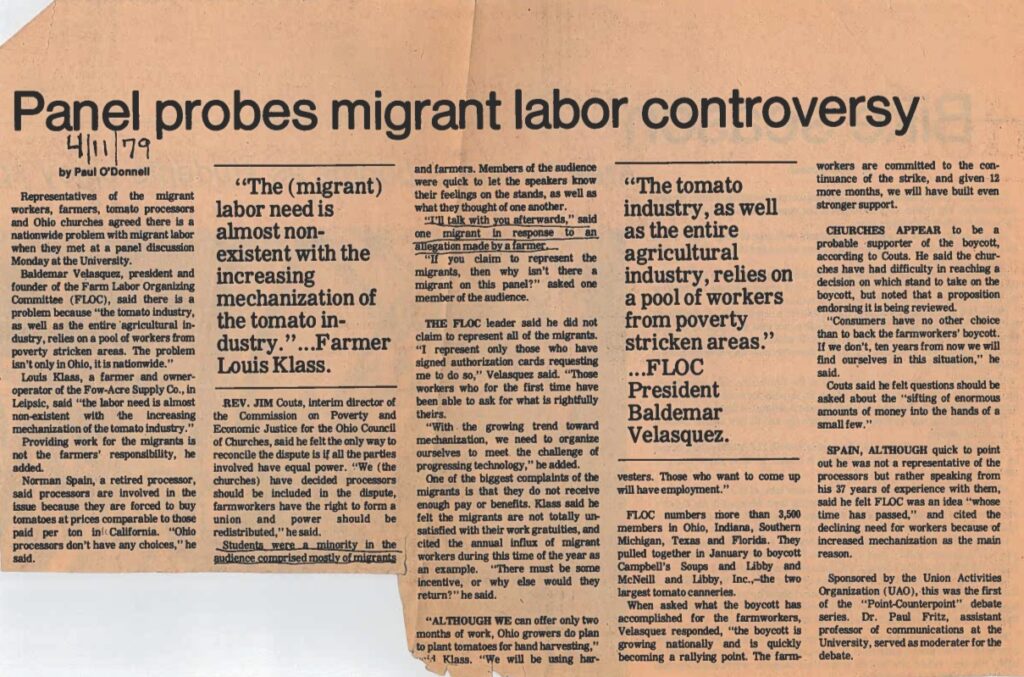
Panel Probes Migrant Labor Controversy
MEET THE DOCUMENT:
This document is a newspaper article from April 11th, 1979. It was published in the BG News. This item comes from the BGSU archives and is in the LSU collection 096. It is located in Box 5, folder 16. The document is a cut out of a newspaper focusing on this article, which does not include pictures.
OBSERVE ITS PARTS:
Paul O’Donnel, a writer for the BG News, wrote this newspaper article. As this document is a newspaper article, the receivers were anyone in BG who got the newspaper. There were potentially thousands of people who read this article upon its release. This article is from 1979. It was published in the town of Bowling Green, Ohio.
TRY TO MAKE SENSE OF IT:
This article was written to cover a panel that was convened in BG. This panel was brought together to deal with nationwide issues of migrant labor. “The tomato industry, as well as the entire agricultural industry, relies on a pool of workers from poverty-stricken areas.” – FLOC president Baldemar Velasquez. Three thousand five hundred members of FLOC from Ohio, Indiana, Michigan, Texas, and Florida were boycotting the largest tomato canneries. According to a farmer, “The migrant labor need is almost nonexistent with the increasing mechanization of the tomato industry.” A processor representative said that he felt the time for FLOC had passed. This is the year that the US and China established diplomatic relations. Also, just one year after this occurred, nearly 3000 farmers drove their tractors to DC to protest farm foreclosure.
USE IT AS HISTORICAL EVIDENCE:
One of the exciting things that I learned from this document is that there were debates regarding the boycotts. This article covers a panel discussion that included the FLOC leader and industry representatives. Also, the government believed the only way to reconcile the issue was to have both groups equal power. This is even though, in reality, the processors had the majority of the power in this situation. The document I am using to help understand this event is the third document of my timeline, Health of migrants and Facts about farm workers. This document shows how the workers were underage, mistreated, and underpaid—proving that the processors were the ones with power.